Hospital knowledge base for patient service.

Smart Hospital
Subei People's Hospital moves from AI applications to reusable AI capability.
SenseCare and Subei People's Hospital deploy a full-process AI system across patient service, digital human service and clinical documentation.
Case Summary
Subei People's Hospital
The Subei case shows SenseCare's DaYi-powered hospital workflow moving from single tools to a reusable hospital AI center. Subei Medical Road, outpatient digital human service, outpatient medical record generation and inpatient documentation capabilities form a system that can keep expanding.
Model size for medical record generation.
Patient service, outpatient records and inpatient documentation.
Subei Medical Road connects smart triage, hospital knowledge Q&A, report interpretation, medicine-box recognition and navigation.
A digital human service will use more than 3,000 authoritative hospital knowledge entries.
AI outpatient medical record generation captures doctor-patient conversations and writes structured records back into hospital systems after physician review.
The inpatient record generation roadmap covers surgery records, discharge summaries, admission notes, first progress notes and ward-round records.
A patient-facing AI super entry
Subei Medical Road has been connected to the hospital's internet hospital as a patient-facing AI agent. Patients can use it before arrival for smart triage and registration support, during the visit for navigation, and after leaving the hospital for report interpretation and medication guidance.
The service is designed to make each step of the patient journey more understandable. It connects smart triage, hospital knowledge Q&A, report interpretation, medicine-box recognition and navigation in one entry point.
Digital human service in the outpatient hall
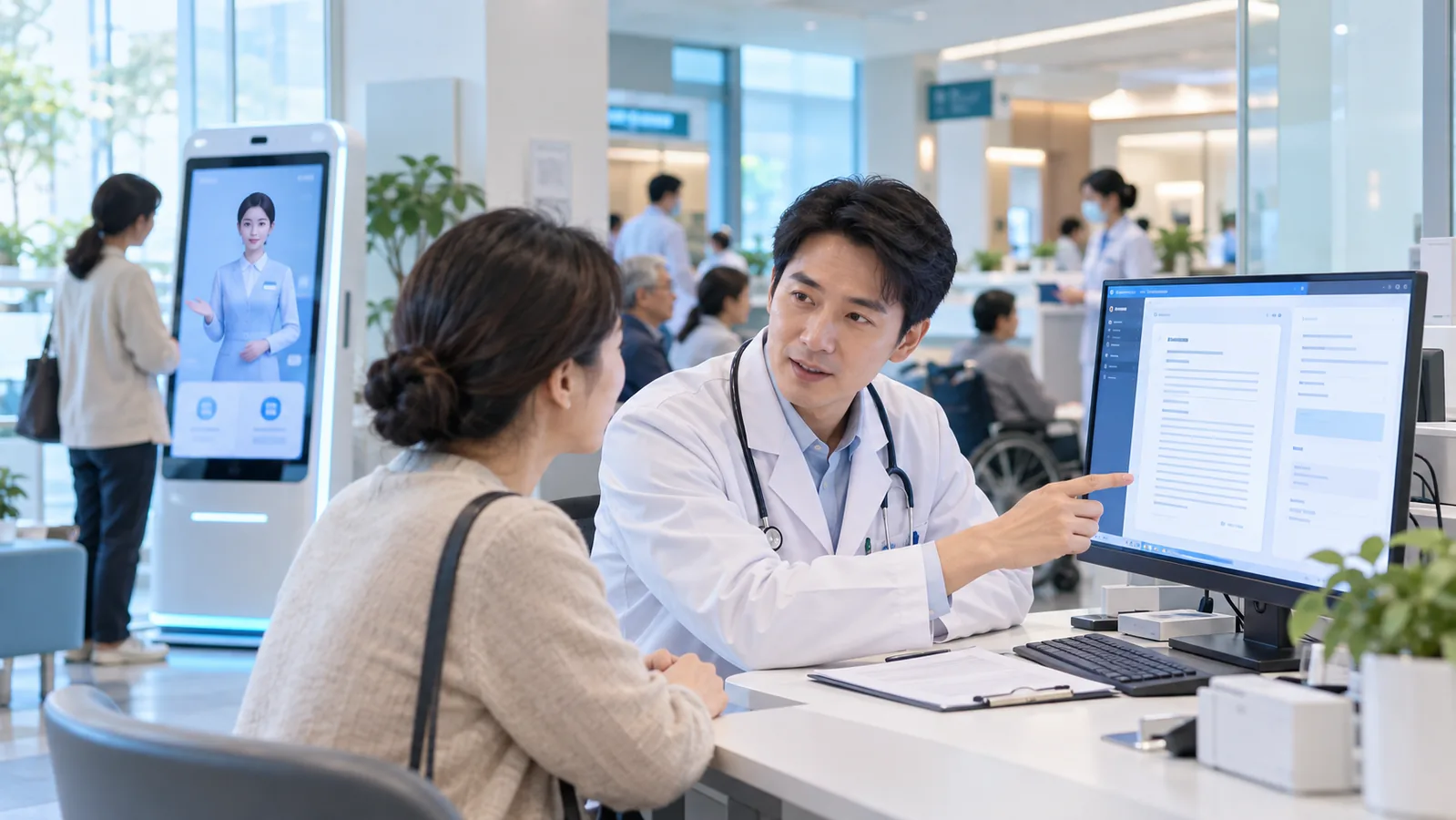
The hospital is also preparing a large-screen digital human service based on more than 3,000 authoritative hospital knowledge entries. The digital human has a hospital-specific visual identity and covers patient service, medical service, health management and hospital information.
It can answer nearly 20 categories of questions, including department guidance, physician introductions, care processes and insurance policies, giving patients a more patient and consistent service experience in the outpatient hall.
Let the stethoscope stop being tied to the keyboard
In clinical assistance, the hospital focuses on reducing the time that medical record writing takes away from diagnosis and communication. The AI outpatient record generation agent captures doctor-patient conversation, combines pre-consultation information and historical visit data, and generates a structured outpatient record draft.
The physician remains responsible for final review and confirmation. AI records, retrieves and organizes information, while doctors make medical judgments and decisions.
Trustworthy generation in private deployment
Real hospital deployment requires active control of hallucination risk. Under private deployment constraints, SenseCare uses a stronger 35B large model for medical record generation and combines it with medical logic orchestration and a proprietary medical knowledge base.
This approach is designed to improve semantic understanding, generation quality and traceability while keeping the system usable inside the hospital's infrastructure environment.
From application construction to capability construction
The cooperation is not a one-off deployment of several independent AI applications. SenseCare provides computing power, models, knowledge and applications as an integrated AI center deeply embedded into existing hospital systems.
With this shared foundation, Subei People's Hospital can continue expanding into inpatient documentation, multimodal clinical decision support, patient profiles, health records and hospital management scenarios.
Related Products