PathOrchestra training scale.

Pathology Foundation Model
Shanghai Pulmonary Hospital advances pathology Vibe Research with PathEngine.
SenseCare's pathology foundation model platform reframes pathology AI development as Vibe Research: clinicians describe the problem, the platform helps train and validate a model.
Case Summary
Shanghai Pulmonary Hospital
PathEngine is SenseCare's foundation-model infrastructure for pathology AI. Built on PathOrchestra, the platform combines slide management, AI-assisted diagnosis and zero-code model production so pathology departments can become model creators, not only AI users.
Evaluation coverage for PathOrchestra.
Approximate deployment footprint for PathEngine.
Selected Shanghai Pulmonary Hospital pathology reports.
PathOrchestra was trained on 287,424 whole-slide images across 21 organ categories.
The model was evaluated on 112 clinical tasks, 27,755 WSI and 9.41 million ROI images.
PathEngine has deployed in nearly 30 backbone hospitals, including Xijing Hospital, Shanghai Pulmonary Hospital and Changzhou First People's Hospital.
At Shanghai Pulmonary Hospital, selected pathology report generation time has been shortened by nearly 50%.
The hospital has developed and deployed AI models for pleural and ascitic fluid cytology, bronchial brushing cytology, lung puncture cytology and EBUS-TBNA cytology.
The digital pathology platform supports annual growth of more than 200,000 new slides and over 100 TB of new pathology data.
From Vibe Coding to Vibe Research in pathology
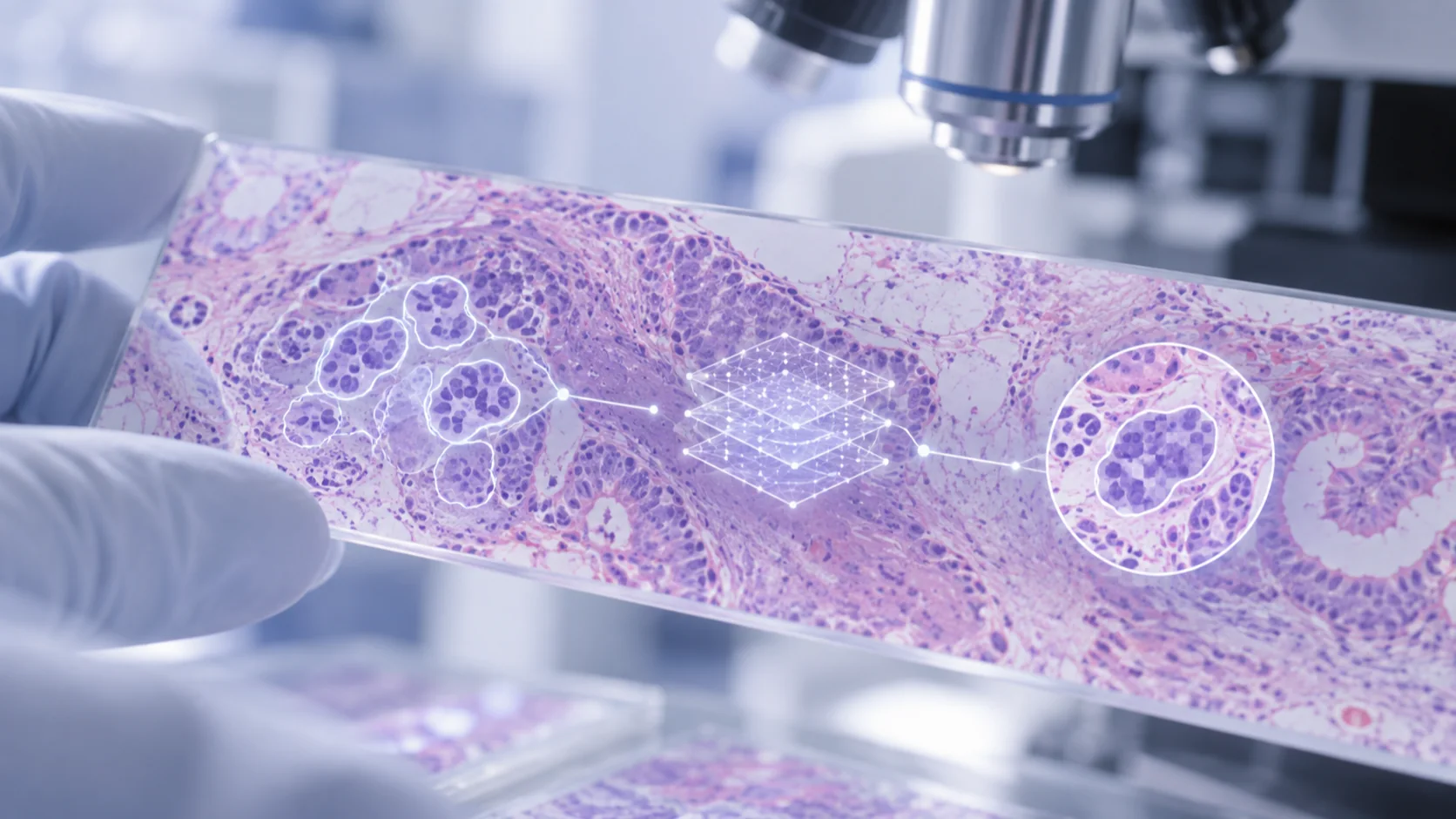
PathEngine brings Vibe Research into pathology: pathologists express clinical intent in natural language, define the disease problem and use the platform to build models without writing code.
With PathEngine, a clinical or research idea can become a model-building task. The physician provides the medical question and domain judgment, while the platform helps organize data, train, evaluate and deploy the model.
A pathology foundation model as the base
PathOrchestra was released with leading pathology experts as China's first pathology foundation model. It was trained on 287,424 whole-slide images across 21 organ categories from authoritative centers, including Xijing Hospital, the First Affiliated Hospital of USTC and TCGA.
The model was evaluated on 112 clinically relevant tasks, 27,755 WSI and 9.41 million ROI images. Across 47 tasks, accuracy exceeded 0.95, making the foundation model a reusable base for downstream pathology AI development.
PathEngine as a zero-code AI production line
Pathology AI faces a long-standing contradiction: clinical demand is industrial in scale, but model development often remains workshop-like. Traditional pathology AI development can take 12-24 months and requires large labeled datasets and algorithm engineers.
PathEngine addresses this by connecting data management, annotation, training, evaluation and release in a zero-code workflow. It integrates PathOrchestra and DaYi so hospitals can build specialty models for long-tail pathology questions more efficiently.
From research platform to clinical value
At Xijing Hospital, the platform supported research that predicts driver mutations in clear-cell renal cell carcinoma from routine HE slides, including VHL, PBRM1, BAP1 and SETD2. The AUC values reached 0.87, 0.84, 0.95 and 0.88, with BAP1 and SETD2 exceeding a general pathology foundation model baseline.
At Shanghai Pulmonary Hospital, the platform supported frozen small-nodule subtype classification and STAS recognition. The models were trained in two months, with AUC above 0.9 in both tasks, showing potential for improving intraoperative reading consistency and extending high-quality pathology capability to broader settings.
The hospital has also used the platform to develop and launch AI-assisted models for pleural and ascitic fluid cytology, bronchial brushing cytology, lung puncture cytology and EBUS-TBNA cytology. Around the frozen small-nodule program, more than 1,200 high-quality annotations and over 800 training iterations supported preliminary clinical validation.
A positive loop for hospital AI production
PathEngine has been deployed in nearly 30 backbone hospitals, including Xijing Hospital, Shanghai Pulmonary Hospital and Changzhou First People's Hospital. The broader collaboration network includes Shanghai Shenkang, Ruijin Hospital, Huashan Hospital, Fudan University Shanghai Cancer Center and others.
The larger signal is that every hospital's clinical practice can become part of the model evolution process. More real scenarios produce better data, better data trains more specialty models, and those models return to clinical validation and research use.
Research Output
Representative pathology AI publications.
PathEngine is supported by a sustained research program spanning pathology foundation models, vision-language learning, multimodal diagnosis and clinical-grade validation.
A generalizable pathology foundation model using a unified knowledge distillation pretraining framework
Nature Biomedical Engineering, 2026
PathOrchestra: a comprehensive foundation model for computational pathology with over 100 diverse clinical-grade tasks
npj Digital Medicine, 2025
Cost-effective instruction learning for pathology vision and language analysis
Nature Computational Science, 2025
Spatially aware graph neural networks and cross-level molecular profile prediction in colon cancer histopathology
The Lancet Digital Health, 2022
PathFound: An agentic multimodal model activating evidence-seeking pathological diagnosis
Medical Image Analysis, 2026
OmniPathoVQA: Benchmarking pathology vision-language models with encyclopedia-scale knowledge
Medical Image Analysis, 2026
Parallel Hyper-Prior and Dual-Domain Autoregressive Transformer for Lossless JPEG Recompression of Pathology Images
IEEE Transactions on Medical Imaging, 2026
Pathology-and-genomics Multimodal Transformer for Survival Outcome Prediction
MICCAI Oral, 2023
Related Products